
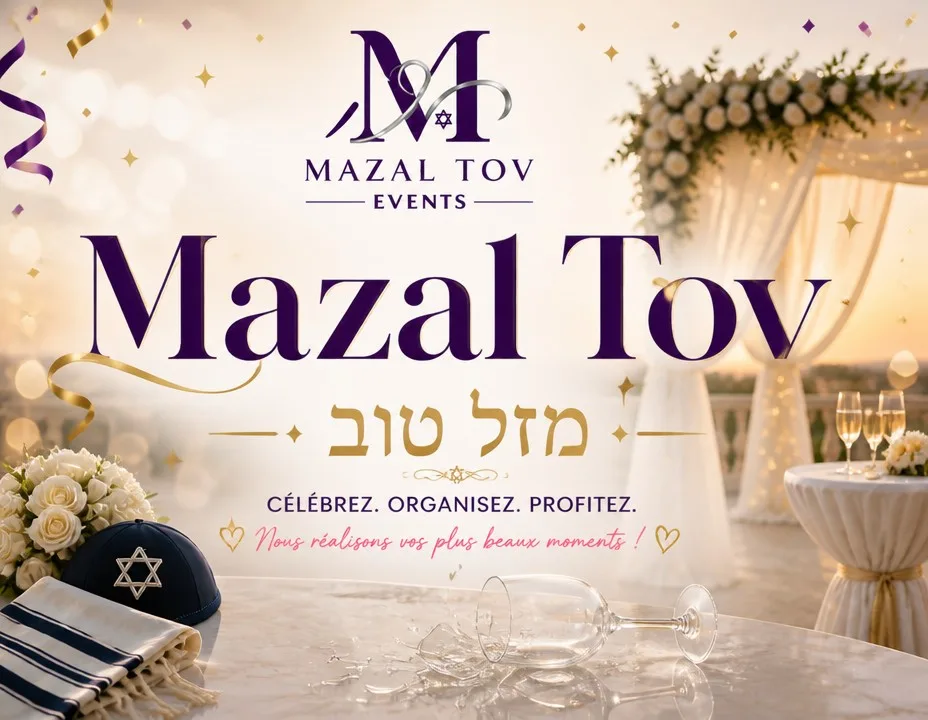
We can hear it under the houppa when the groom breaks the glass, at the end of a Bar Mitsva, at the announcement of a birth... "Mazal Tov!" is probably the most famous Hebrew expression in the world. But what exactly does it mean, where does it come from and when should it (or not) be said? We'll explain everything.
Mazal Tov: translation
In Hebrew, pronounced "mazal toov". Tov means "good." Mazal means luck, destiny. Literally, "Mazal Tov" means "good luck" or "good star".
But in practice, it is not a wish for the future: it is a congratulations. It is said " Mazal Tov" when the happy event took place, to rejoice with the person. It's the equivalent of "Congratulation!" or "All our congratulations!".
Where does the word "mazal" come from?
In ancient Hebrew, the word mazal meant constellations and stars, which were associated with destiny. Over time, he took on the meaning of "luck" or "good fortune". Wishing for a "good mazal" was to wish that the stars were favorable.
The Talmud shades this idea with a famous formula: "Ein mazal le-Israel", "there is no astral destiny for Israel". In other words, destiny is not written in the stars: it also depends on the actions of each.
Mazal Tov or Mazel Tov: What difference?
It's the same expression, pronounced differently:
- Mazal Tov The Israeli and Sefaric pronunciation, the most common in France and Israel.
- Mazel Tov The Ashkenazi pronunciation, which came from Yiddish, is widespread in the United States.
Both are correct. You will also see the spellings "mazaltov", "mazel tov" or "mazal tob".
When do we say Mazal Tov?
Mazal Tov is said for all the joys of life, once the event arrives:
- Marriage It is the cry of joy that follows the broken glass under the houppa, and the signal of the beginning of the feast.
- Engagement or a marriage proposal.
- A Bar Mitsva or a Bat Mitsva, after the rise to the Torah.
- A birthA Brit Mila or a Zeved Habat.
- A degree, a new job, a real estate purchaseAnd all the good news.
When don't you say Mazal Tov?
As Mazal Tov congratulates an accomplished event, it is not said for something that has not yet happened:
- For pregnancy, they say rather "Be-cha'a tova" "at the right time", hoping that everything will go well until birth.
- Prior to a review or new project, we wish "Be-hatsla'ha" "Good" is a good thing.
What can be said about Mazal Tov?
The simplest: "Toda! » ("Thank you!"). We also hear "Amen", or an answer that returns the vow, like "Be-karov etsl'ha" ("nearly home") when the one who congratulates is not yet married.
Siman Tov and Mazal Tov: The Holiday Song
It is impossible to talk about Mazal Tov without mentioning "Siman Tov or Mazal Tov", the traditional song that we sing in the round at weddings, at the Mitsva Bar and at all Jewish festivals. All Jewish DJs and wedding orchestras have it in their playlist: it is often she who launches the first hora of the evening.
And Mazal Tov Events in all this?
If we chose this name, it is because "Mazal Tov" sums up everything we love: shared joy, family and the great stages of life. Mazal Tov Events brings together providers who know your traditions and free tools to organize your wedding, Bar Mitsva or Brit Mila.
Are you planning a simha? Discover the claimants for Jewish marriage, the providers for Bar Mitsva and Bat Mitsva and our guide The 7 steps to organize a Jewish wedding. And in advance: Mazal Tov!